Quick Shop: AS 1905.1 Commercial Door Hardware, Closers & Frame Strikers (Stocked in VIC)
Completing a statutory fire, smoke, or acoustic door assembly? Order compliant locks, hydraulic closers, and anti-rattle strike plates with 24-48hr Victorian dispatch and free shipping over $149.95 AUD:
1. Commercial Fire-Rated Mortice Locks & Leversets: Shop our Commercial Door Locks Hub (Lockwood 3572/3772, Carbine CSM72 & PR6000 2-Hr Fire Rated hardware).
2. Hydraulic Door Closers & Anti-Rattle Strike Plates: Pair perimeter seals with Commercial Door Closers and Anti-Rattle Tab Strike Plates so doors compress acoustic seals cleanly.
3. On-Site Melbourne Fire Door & Locksmith Support: Call All Secure Locksmiths on (03) 9306 6760 or 0421 149 760 for commercial door hardware and seal installation across Metropolitan Melbourne and Regional Victoria.
Specifying the right commercial fire and acoustic door seal package is critical for passing Essential Safety Measures (ESM) building audits, blocking medium-temperature smoke leakage under BCA/NCC Spec C3.4, and preventing corridor noise transfer in apartments, medical consulting suites, and schools. Importantly, perimeter and bottom door seals interact directly with your mortice lock latch spring, strike plate lip tab, and overhead hydraulic door closer latching valve. This technical trade guide explains how automatic drop seals, intumescent fire strips, and meeting-stile astragals work together with your locking hardware.
Commercial Fire and Acoustic Door Seal Systems Explained
Every commercial fire and acoustic door seal assembly addresses three distinct air gaps around a hinged door leaf: (1) the top head and vertical jamb perimeter clearances (typically 2mm to 3mm wide), (2) the bottom threshold gap between the bottom door rail and the finished floor covering (restricted to 3mm to 10mm on statutory fire doors under AS 1905.1), and (3) the vertical meeting stile gap on pairs of double doors.
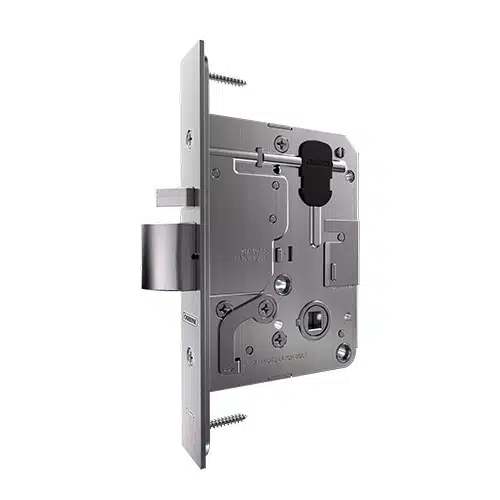
Why Locks & Closers Must Be Matched to Door Seals: Installing thick silicone bulb perimeter seals increases latch resistance at the final 5mm of door travel. Always pair acoustic perimeter seals with a steel strike plate featuring an adjustable anti-rattle tab (from our Door Lock Strikers range) and calibrate Valve 2 (final latching speed 15° to 0°) on your overhead door closer (covered in our Commercial Door Closer Adjustment Guide) so the bevelled mortice latch clicks positively past the compressed seal.

Automatic Drop Down Door Seal: Zero-Drag Acoustic & Smoke Control
Unlike fixed bristle brush strips that drag across hallway carpet and wear out quickly, an automatic drop down door seal (either semi-morticed into a 15mm x 30mm groove routed into the bottom rail of a solid timber door or surface-mounted in an anodised aluminium carrier) holds its internal neoprene or silicone gasket retracted while the door swings open. Only when the door reaches the final 5mm of closing does the hinge-side brass actuation plunger contact the frame jamb stop, deploying the seal straight down onto the floor threshold in a level scissors motion.
When adjusting an automatic drop down door seal on a strata apartment entry or medical consulting room door, wind the hex plunger clockwise to reduce downward pressure or counter-clockwise to increase seal drop (up to 15mm maximum drop). If the plunger is wound out too far, the bottom seal will bind prematurely against the floor at 10 degrees open and prevent the overhead closer from latching the lock.
Intumescent Fire and Smoke Door Seals Under AS 1905.1 & AS 1530.4
Understanding intumescent fire and smoke door seals is essential for building compliance under National Construction Code (NCC) fire compartmentation rules. Combined fire-and-smoke perimeter strips contain two functional components inside a rigid PVC carrier: (1) a flexible elastomeric twin-fin or brush blade that blocks ambient cold and medium-temperature (200°C) smoke immediately when a fire starts, and (2) a graphite or sodium-silicate intumescent core that expands to 5-10 times its volume once temperatures exceed 150°C-200°C, sealing the perimeter gap between the door leaf and frame to maintain 1-hour to 4-hour fire resistance.
Whenever carpenters replace a primary mortice lock body (such as a Lockwood 3572 or Carbine CSM72) on a door fitted with intumescent fire and smoke door seals, ensure the continuous perimeter frame seal is never cut away across the strike plate zone unless specified in the tested fire door schedule.
Meeting Stile Astragal Door Seal Rules for Commercial Double Doors
On pairs of commercial double doors in corridors, plant rooms, and auditoriums, the central vertical gap between the active leaf (fitted with the primary mortice lock or panic bar) and the inactive leaf (secured with top and bottom commercial flush bolts) must be sealed using a meeting stile astragal door seal. Depending on whether both leaves swing in the same direction or operate as double-egress doors, trade installers fit either an overlapping T-astragal (creating a physical rebate stop against jemmy attacks) or twin opposing silicone fin seals that allow independent leaf movement.
If an overlapping metal or timber meeting stile astragal door seal is fitted to a fire-rated double door pair, a mechanical Door Coordinator (Sequence Selector) must also be installed along the top head frame so the inactive flush-bolted leaf always closes ahead of the active latched leaf.
Frequently Asked Questions
What is the maximum allowed gap under an Australian fire door?
Under AS 1905.1, the clearance between the bottom of a fire door and the finished floor must reside between 3mm and 10mm (or up to 25mm only when fitted with a tested fire-rated commercial fire and acoustic door seal assembly approved for that specific door core).
Why does my fire door stop 5mm short of latching after fitting new perimeter seals?
New silicone perimeter gaskets or an over-extended automatic drop down door seal plunger add compression resistance right at the strike lip; adjust the anti-rattle tab on your strike plate slightly and open Valve 2 (latching speed) on your overhead door closer by 1/8th of a turn counter-clockwise.
Who can supply and install compliant fire door locks, closers, and seals in Melbourne?
Order AS 1905.1 mortice locks, closers, and strike plates online at The Lock Warehouse for 24-48hr Victorian dispatch, or call (03) 9306 6760 / 0421 149 760 to book on-site commercial installation via All Secure Locksmiths for any commercial fire and acoustic door seal and hardware upgrade.